I was just sitting here at my favorite hang out of late, Stauf's coffee shop and thinking about resent blog posts. I tend to blog about certain topics more than others at any given time. This can be because of my mood, or because something particularly interesting is going on in the world, or because I'm a flake and can't hold my attention on one thing all the time so have many many varied interests.
This got me thinking about the amount of spiritual or Christian centered posts I've written. There haven't been many recently and I've certainly have had plenty to write about. There is a lot of chatter going on these days about climate change, and climate change action, and energy bills, and there is a lot I can say on those topics, both from an environmentalists point of view but especially as a Christian. In fact, any topic I write about is from the point of view as a Christian.
When I write about my struggles, or my joys, or just daily life, I don't ever really say where my strength is coming from, or why I have the beliefs that I do. And I guess for me, I don't have to.
Everything I do and say is because and informed by the fact that I believe and trust in Jesus.
Perhaps I don't say this enough, but it has become such a part of me that I don't feel that I need to. Yes I'm a Christian, yes I read the Bible for guidance, yes I ask God for help and strength. But with every decision I make and every emotion I express I am not going to say this. But I also acknowledge that it's people's right and joy to do so for themselves.
I'm also not saying that I don't share my faith with others, because I do (like I am doing right here in this blog post). What kind of follower of Jesus would I be if I didn't? But personally I find a time and a place for everything. I would rather show people about my beliefs than to sit down and give them a speech.
So remember when you read this, what informs me first and foremost. But also remember that I am not perfect, that sometimes when my intentions are good, my actions are not always the best. I may slip up and do something very un-Christian like. It happens, maybe everyday. But please forgive me. :)

Showing posts with label spiritual. Show all posts
Showing posts with label spiritual. Show all posts
Wednesday, October 28, 2009


Tuesday, February 24, 2009
Yoga

So, I can't believe I haven't written about this yet, but I guess that's just the way things are.
I've been practicing yoga for several months now. It is one of the best experiences of my life, the fitness aspect as well as the life, body, mind centering that it brings. I practice at a studio just a few blocks from where I live called Grow Yoga. I just finished the first 8 week beginner Hatha series. Of course I did not participate in all 8 weeks, because of my condition I missed out on 3 of them, but hope to continue going on Tuesday mornings.
I've become stronger after the sedentary life I had been living because of my condition. I am also more flexible than I have ever been. Which just blows my mind. The benefits yoga has brought to my life are innumerable.
I will say this about the practice of yoga:
- No matter what your religious or spiritual beliefs are, for at least a few moments during your practice you can become centered on that one thing that holds your life together.
- You become more aware of yourself, both in how your body moves and how your mind works.
- You can come to each practice moving only in the way your body will allow you. This is most important for me, because of all the chronic pain and fatigue I experience.
- From day to day you may not know what your abilities are going to be, but you can always participate in the practice of yoga as your body allows you to move in only comfortable non-harmful ways.
Because I am a new yogi on this journey I am not going to recommend any specific practice or style that may be better than another. I am not going to tell you to go out and spend money on any one particular book or DVD. But I do want to encourage you, if you feel that your body could use some movement and you can't find the one thing that works for you, seek out a yoga class. Hatha yoga is perfect for beginners. Be careful of classes that claim to be power yoga or hot yoga, while these are valid practices, if you have any kind of chronic condition that causes pain, weakness or fatigue, they would not be helpful classes for you.
Don't be afraid to ask questions before you take a class, meet the instructor, make sure they know your specific needs. If a particular instructor is not willing to listen about your limitations, then move on and find someone new. This is not advice just for those of us in chronic pain, but everyone. You need to find what works for you and not just what happens to be the biggest or most popular class.
You will not master all poses immediately, but you may find that some things come more easy than others. Work on those, but also challenge yourself into poses that give you problems. I have benefited from working my body in as many directions as possible. I have better posture, and I feel healthier from it.
Because of the benefits I have received from yoga as a person in chronic pain, I've launched on a quest to learn all I can about the practice of yoga, and I would like to train to become a teacher specializing in helping those in chronic pain. This isn't going to take place immediately as the amount of knowledge to be acquired by a yoga instructor is vast, and I do not want to rush my study because I want to enjoy the journey, and hopefully bring my experiences to help others like me.
As for what other paths I will be taking in the future, they are still unknown, but I trust they will be revealed in time. In yoga we end with the word Namaste, meaning "the light in me honors the light in you." This warrants it's own post in itself relating to my experiences in India. But for now I will just finish this post with Namaste.
Sunday, December 07, 2008
Second Sunday of Advent
Mark 1:1-8 (The Message)Mark 1
John the Baptizer
1-3The good news of Jesus Christ—the Message!—begins here, following to the letter the scroll of the prophet Isaiah.Watch closely: I'm sending my preacher ahead of you;He'll make the road smooth for you.Thunder in the desert!Prepare for God's arrival!Make the road smooth and straight!4-6John the Baptizer appeared in the wild, preaching a baptism of life-change that leads to forgiveness of sins. People thronged to him from Judea and Jerusalem and, as they confessed their sins, were baptized by him in the Jordan River into a changed life. John wore a camel-hair habit, tied at the waist with a leather belt. He ate locusts and wild field honey.
7-8As he preached he said, "The real action comes next: The star in this drama, to whom I'm a mere stagehand, will change your life. I'm baptizing you here in the river, turning your old life in for a kingdom life. His baptism—a holy baptism by the Holy Spirit—will change you from the inside out."
I tried to find a good image of John the Baptist but the pickings, at least to my standards, were slim. Most of the art is either the Baptism of Jesus, or the beheading of John the Baptist. Or just a saintly image. Any photographs that may be described as living art remind me too much of Monty Python. So I suppose you will have to create your own picture here.
Let me help... Imagine Ryan, coming out of the woods at you, wearing a camel hair dress, with a leather belt. He carries with him his lunch, in a sachel, consisting of locusts and wild honey. Come to think about it, it's not that hard of an image to imagine. But I digress.
John the Baptist came to prepare the way of Jesus, speaking of forgiveness of sins, and apparently this was good news because thousands flocked to him to confess their sins and be baptized. I doubt it was his handsome appearance, but more of the message that he was bringing. The message of the coming of Christ.
This week, imagine yourself as a sort of John the Baptist. I'm not asking you to eat locust, but I sure do love honey. Spread the news of the coming of Christ, the forgiveness of sins, and life in the New Kingdom.
Saturday, December 06, 2008
Directions
Several weeks ago, I experienced my first real life crisis, the thought of wanting to take my own life, and the inability to rationalize any reason not to. Since then, as I've been going through treatment, I've been thinking about my life. What directions do I want to go in, or what directions do I have the ability to go in. Right now, I feel like I'm going in circles. A few weeks ago I wrote about being on a roller coaster that wasn't fun anymore, I didn't really leave any explanation to the post, but my emotions are going up and down and sideways all the time, without any real rhyme or reason.
I have so many passions, so many deep feelings for the people of this world and for the environment. At the same time, I have so much going on in my own life. I have to get myself on a more straight road, before I can help others. I can't be much help to people when I don't know if I will be able to get out of bed from one day to another. And this frustrates me.
Right now this blog seems to be the only connection I have with the world. The only way to get the word out about what I see as important, what I see as needing to be done. Yet sometimes I don't think that people are listening. I began this blog because I felt I had something to say. This is how my first blog post reads:
Here I am, starting yet another blog. It's not because I'm trying to be cool or popular, but because I really have things to say. I do some writing over on Myspace, but it's really not cutting it for me. I spend too much time learning about people's private lives and not saying what I have to say, which is sometimes important. Also I wasn't spending enough time outside...I wasn't enjoy nature, God's creation. Now I am trying to spend much less time on the computer and much more time among the trees.
I am here to post my opinions and tell the world what I have to say. Please comment if you have something to add to the discussion, even if it's disagree with what I have to say. Nothing will never get resolved if there is no dialogue.
Now as I'm stuck with the directions of my life, I am also stuck with the directions of this blog. I didn't think it was possible but over the last two years, I have found more things that I need to tell people about. I began with the church, with spirituality, religion, and the environment. I added bits in pieces of my daily life, hoping to show my beliefs in how I live. Then came the GREAT PNEUMONIA INCIDENT, this kept me from blogging for several months, due to the fact that I could barely breath, or get out of bed.
Then with the diagnosis of many chronic illnesses, I turned the attention to this blog to advocating for awareness and understanding. I saw this as an important aspect of my life, but it did not have much of a place in a blog about Christianity and the Environment. Also, with my recent crisis, I've become more involved in mental health awareness, and have been interested in keeping everyone I care about informed of my daily struggles. Which this blog has also been ideal in serving in that purpose.
So here I am, expanding my horizons in the blogging world. But I'm stuck, feeling like Dorothy on the Yellow Brick Road, and the Scarecrow is telling me which way to go. Do I keep just one blog, and hope that the range of things I write about keep people interested enough to come back. Or do I begin again with another blog separating the original Living in the MidWest about my life, Christianity, and the Environment, starting a new blog about chronic physical and mental illness, and my struggle with those. Would I be able to keep up, would people read both, or would I just be stuck with two blogs, and no readers?
I've been going over this for some time now. In reality I am fulfilling what my initial intention of this blog was, writing because I felt I had something important to say. The scope of those important things have just been broadened since September of 2006.
Please advise on this subject, because I've come to a cross roads and the scarecrow is not cutting it.
Wednesday, December 03, 2008
Advent

It's here. I'm excited, are you? Get excited......
For what you might ask? For presents, for the opportunity to take off work and travel? No, I'm not talking about Christmas, I'm talking about Advent. About the anticipation of the coming of Christ.
What could be more exciting?!
It's already Wednesday, I kind of dropped the ball getting a post about the first Sunday of Advent. So I will start there, and hope to post again on Sunday.
On the first Sunday of Advent we light the candle of Hope. I've been celebrating Advent my whole life, particularly in the United Methodist Church. My mother has been in charge of buying the candles and setting up the wreath for as long as I can remember. I also remember as an acolyte lighting the first purple candle after the Scripture had been read. I was always nervous about lighting it at the right time. If I lit it too soon, then I would have to stand there, all silly like, while the pastor finished the reading. If I waited too long and the reading was over, the congregation would stare as I attempted to light a fresh candle, which is never an easy task. But I guess that's what Advent is about, waiting, for the right time.
I'm pondering the Old Testament scripture that is designated for the first Sunday of Advent this particular year.
Isaiah 64:1-9
64:1 O that you would tear open the heavens and come down, so that the mountains would quake at your presence--
64:2 as when fire kindles brushwood and the fire causes water to boil-- to make your name known to your adversaries, so that the nations might tremble at your presence!
64:3 When you did awesome deeds that we did not expect, you came down, the mountains quaked at your presence.
64:4 From ages past no one has heard, no ear has perceived, no eye has seen any God besides you, who works for those who wait for him.
64:5 You meet those who gladly do right, those who remember you in your ways. But you were angry, and we sinned; because you hid yourself we transgressed.
64:6 We have all become like one who is unclean, and all our righteous deeds are like a filthy cloth. We all fade like a leaf, and our iniquities, like the wind, take us away.
64:7 There is no one who calls on your name, or attempts to take hold of you; for you have hidden your face from us, and have delivered us into the hand of our iniquity.
64:8 Yet, O LORD, you are our Father; we are the clay, and you are our potter; we are all the work of your hand.
64:9 Do not be exceedingly angry, O LORD, and do not remember iniquity forever. Now consider, we are all your people.
Isaiah sounds so desperate, so longing for change, longing for change by God.
In verse 6 it says "we all fade like a leaf," right now in Ohio the leaves have faded, it is now December and the city has started cleaning up the piles of leaves in the street.
I always have a hard time reading about an angry God, I like to think of the saving acts of Jesus, without remembering the creative acts of God in the Hebrew people. Isaiah acknowledges the anger of God, but also is reminded that God is the potter and we are the clay.
This week, or the second half of this week, lets be like clay and let God mold us into what God wants us to be as we wait for the coming of Christ this Advent season.
Wednesday, November 05, 2008
today
Today was a combination of OK and OK. I didn't feel particularly one way or the other. I had an incredibly emotional day yesterday and just needed things to even out.
I've come through my time of crisis, shared my experiences, feelings and doubts. Now as I move on to the time of recovery, which may take awhile, I need to reflect on items of disclosure. What am I going to share about my diagnosis's, my treatments, and any set back I might have.
So if things seem slower on the crazy side :) That is why.
Over the next few months I want to continue to provide you with information on social justice and insight on environmentalism and Christianity, as well as bring information about chronic illnesses, including mental illnesses to those who might not otherwise have a reason to read about them on their own.
I hope you enjoy.
Sunday, September 14, 2008
Brother Sun, Sister Moon
Canticle of Brother Sun and Sister Moon of St. Francis of Assisi
Most High, all-powerful, all-good Lord, All praise is Yours, all glory, all honour and all blessings.
To you alone, Most High, do they belong, and no mortal lips are worthy to pronounce Your Name.
Praised be You my Lord with all Your creatures,
especially Sir Brother Sun,
Who is the day through whom You give us light.
And he is beautiful and radiant with great splendour,
Of You Most High, he bears the likeness.
Praised be You, my Lord, through Sister Moon and the stars,
In the heavens you have made them bright, precious and fair.
Praised be You, my Lord, through Brothers Wind and Air,
And fair and stormy, all weather's moods,
by which You cherish all that You have made.
Praised be You my Lord through Sister Water,
So useful, humble, precious and pure.
Praised be You my Lord through Brother Fire,
through whom You light the night and he is beautiful and playful and robust and strong.
Praised be You my Lord through our Sister,
Mother Earth
who sustains and governs us,
producing varied fruits with coloured flowers and herbs.
Praise be You my Lord through those who grant pardon for love of You and bear sickness and trial.
Blessed are those who endure in peace, By You Most High, they will be crowned.
Praised be You, my Lord through Sister Death,
from whom no-one living can escape. Woe to those who die in mortal sin! Blessed are they She finds doing Your Will.
No second death can do them harm. Praise and bless my Lord and give Him thanks,
And serve Him with great humility.
Most High, all-powerful, all-good Lord, All praise is Yours, all glory, all honour and all blessings.
To you alone, Most High, do they belong, and no mortal lips are worthy to pronounce Your Name.
Praised be You my Lord with all Your creatures,
especially Sir Brother Sun,
Who is the day through whom You give us light.
And he is beautiful and radiant with great splendour,
Of You Most High, he bears the likeness.
Praised be You, my Lord, through Sister Moon and the stars,
In the heavens you have made them bright, precious and fair.
Praised be You, my Lord, through Brothers Wind and Air,
And fair and stormy, all weather's moods,
by which You cherish all that You have made.
Praised be You my Lord through Sister Water,
So useful, humble, precious and pure.
Praised be You my Lord through Brother Fire,
through whom You light the night and he is beautiful and playful and robust and strong.
Praised be You my Lord through our Sister,
Mother Earth
who sustains and governs us,
producing varied fruits with coloured flowers and herbs.
Praise be You my Lord through those who grant pardon for love of You and bear sickness and trial.
Blessed are those who endure in peace, By You Most High, they will be crowned.
Praised be You, my Lord through Sister Death,
from whom no-one living can escape. Woe to those who die in mortal sin! Blessed are they She finds doing Your Will.
No second death can do them harm. Praise and bless my Lord and give Him thanks,
And serve Him with great humility.
Sunday, August 31, 2008
Prayer Life
I have been pretty down on myself about my prayer life and lack of prayer lately. Thinking that I've really sucked at keeping up my part of the conversation. After I asked for prayers for those in the path of the hurricane, I got to thinking about my prayer habits and what they have really been like over the past few months.
I've been struggling with most daily activities, so I thought that prayer obviously had gone by the wayside. Daily, people tell me that they are praying for me, for my comfort, my treatment, for more good days. And every time I say "yes, please do, I really appreciate it." All of this time I was thinking about how I was lacking in this department, that I wasn't praying the way I should be in this time of my life.
And then I got to thinking about people who I find important in my life, people who are struggling with things that may be similar or vastly different than what I am handling. I was thinking about friends from home, friends in Columbus, friends across the country, and how often I think of them. And I realized that every time I think of them, and imagine what it would feel like to be them, I offer up a little prayer for their safety, for guidance, for comfort. So, my prayer life might not have dried up as much as I thought it had.
I sure am grateful for all the prayers I have received, and for all the ways I've been blessed in my life, and I make that gratefulness known on a regular basis. But how often do I actually pray for myself? I keep everyone else in my life so uplifted in prayer, that I often forget the one person I am closest to. Then I get down on myself because I am not praying the way I should be. I've been rereading Anne Lamott's Traveling Mercies and she talks about sometimes her prayers consist of "help me, help me, help me" and "thank you, thank you, thank you." If this is enough for her, could it possibly be enough for me?
I also recently read Elizabeth Gilbert's Eat, Pray, Love where a friend tells her that she should not be afraid to ask for exactly what we want. Glibert like myself does not feel comfortable doing this, but her friend encourages her do to so, explaining that her case will at least be heard. This makes sense, what I want, may not be the thing that God wants for me, but it doesn't hurt to ask. Just like it doesn't hurt to ask Santa for a pony. I'm going to try not to be disappointed if what I want doesn't line up with what God is doing in my life... But who knows maybe I will get even just a portion of what I ask for.
So I will continue to pray for those who I love and care about, for those who I haven't met yet, and I will continue to give praise for all the blessings I have received. But perhaps from now on, I will add a little petition for myself, in hopes that I will be led in the direction that works for everyone.
Know that I am praying for you.
I've been struggling with most daily activities, so I thought that prayer obviously had gone by the wayside. Daily, people tell me that they are praying for me, for my comfort, my treatment, for more good days. And every time I say "yes, please do, I really appreciate it." All of this time I was thinking about how I was lacking in this department, that I wasn't praying the way I should be in this time of my life.
And then I got to thinking about people who I find important in my life, people who are struggling with things that may be similar or vastly different than what I am handling. I was thinking about friends from home, friends in Columbus, friends across the country, and how often I think of them. And I realized that every time I think of them, and imagine what it would feel like to be them, I offer up a little prayer for their safety, for guidance, for comfort. So, my prayer life might not have dried up as much as I thought it had.
I sure am grateful for all the prayers I have received, and for all the ways I've been blessed in my life, and I make that gratefulness known on a regular basis. But how often do I actually pray for myself? I keep everyone else in my life so uplifted in prayer, that I often forget the one person I am closest to. Then I get down on myself because I am not praying the way I should be. I've been rereading Anne Lamott's Traveling Mercies and she talks about sometimes her prayers consist of "help me, help me, help me" and "thank you, thank you, thank you." If this is enough for her, could it possibly be enough for me?
I also recently read Elizabeth Gilbert's Eat, Pray, Love where a friend tells her that she should not be afraid to ask for exactly what we want. Glibert like myself does not feel comfortable doing this, but her friend encourages her do to so, explaining that her case will at least be heard. This makes sense, what I want, may not be the thing that God wants for me, but it doesn't hurt to ask. Just like it doesn't hurt to ask Santa for a pony. I'm going to try not to be disappointed if what I want doesn't line up with what God is doing in my life... But who knows maybe I will get even just a portion of what I ask for.
So I will continue to pray for those who I love and care about, for those who I haven't met yet, and I will continue to give praise for all the blessings I have received. But perhaps from now on, I will add a little petition for myself, in hopes that I will be led in the direction that works for everyone.
Know that I am praying for you.
Tuesday, October 23, 2007
The Prayer of Bishop Romero
The following is a prayer that is contributed to Archbishop Oscar Romero who was assassinated during a mass in San Salvador in 1980. While, in fact these words were written by someone else, and never spoken by Romero, they are said to encompass his spirit. They certainly have been helpful to me over the last few months and I wanted to share them here. I hope you enjoy.
It helps, now and then, to step back
and take the long view.
The kingdom is not only beyond our efforts,
it is beyond our vision.
We accomplish in our lifetime only a tiny fraction of
the magnificent enterprise that is God’s work.
Nothing we do is complete,
which is another way of saying
that the kingdom always lies beyond us.
No statement says all that could be said.
No prayer fully expresses our faith.
No confession brings perfection.
No pastoral visit brings wholeness.
No program accomplishes the church’s mission.
No set of goals and objectives includes everything.
This is what we are about:
We plant seeds that one day will grow.
We water seeds already planted, knowing that they hold future promise.
We lay foundations that will need further development.
We provide yeast that produces effects beyond our capabilities.
We cannot do everything
and there is a sense of liberation in realizing that.
This enables us to do something,
and to do it very well.
It may be incomplete, but it is a beginning, a step along the way,
an opportunity for God’s grace to enter and do the rest.
We may never see the end results,
but that is the difference between the master builder and the worker.
We are workers, not master builders,
ministers, not messiahs.
We are prophets of a future not our own. Amen.
It helps, now and then, to step back
and take the long view.
The kingdom is not only beyond our efforts,
it is beyond our vision.
We accomplish in our lifetime only a tiny fraction of
the magnificent enterprise that is God’s work.
Nothing we do is complete,
which is another way of saying
that the kingdom always lies beyond us.
No statement says all that could be said.
No prayer fully expresses our faith.
No confession brings perfection.
No pastoral visit brings wholeness.
No program accomplishes the church’s mission.
No set of goals and objectives includes everything.
This is what we are about:
We plant seeds that one day will grow.
We water seeds already planted, knowing that they hold future promise.
We lay foundations that will need further development.
We provide yeast that produces effects beyond our capabilities.
We cannot do everything
and there is a sense of liberation in realizing that.
This enables us to do something,
and to do it very well.
It may be incomplete, but it is a beginning, a step along the way,
an opportunity for God’s grace to enter and do the rest.
We may never see the end results,
but that is the difference between the master builder and the worker.
We are workers, not master builders,
ministers, not messiahs.
We are prophets of a future not our own. Amen.
Monday, October 15, 2007
Environmentalism as an act of Prayer
I think it would be helpful for us as Christians in the 21st century to take advice from our first and second century Desert Mothers and Fathers when they said to "pray always." The mothers and fathers weren't encouraging each other to sit in silence and stillness and pray all day, although they did do this on occasion. What they were encouraging was the act of prayer to intersect with their daily lives. Most Mothers and Fathers did tasks throughout the day that helped them live, weaving was one of these tasks. And as they weaved they would pray, as they ate they would pray, and as they would participate in the taking care of those in need, they would pray.
How would this life of prayer fit into your daily routine? Do you posses the discipline it takes to "pray always?" It sounds daunting, if not terrifying, however some daily tasks are not far off from acts of prayer.
This is where the environment comes in. Have you ever thought about environmentalism as an act of prayer? Let's think about a few aspects of a daily life, that as people who care about the environment might take part in.
How would this life of prayer fit into your daily routine? Do you posses the discipline it takes to "pray always?" It sounds daunting, if not terrifying, however some daily tasks are not far off from acts of prayer.
This is where the environment comes in. Have you ever thought about environmentalism as an act of prayer? Let's think about a few aspects of a daily life, that as people who care about the environment might take part in.
- The first thing that comes to mind is gardening. Tilling the earth, planting a seed, and then tending a garden. The earliest monastics did it and some still do today. This garden provides for those who are tending it as well as perhaps those that are not able to plant their own garden. How can this not be an act of prayer? If you have spent much time in a garden, you know the connection that one develops with the earth, the earth that God created for us. So in the garden, pray a prayer of thankfulness for the ability to provide for ourselves and for others, as well as the enjoyment of just being among God's creation in the Garden.
- What about planting a tree? This is close to tending a garden but slightly different. Planting a tree is more of a long term commitment. You are saying to God that you love the creation God has given us and are will to participate in the upkeep of creation for the long hall.
- One that you probably haven't given much thought to is the act of recycling. Much like the repetitive task that the early Mothers and Fathers had in weaving, we find ourselves constantly sorting, bagging, and moving recyclables. What do you think about when you are participating in the act of recycling? Most likely you are going over daily plans in your head, or thinking how dirty of a job it can be sometimes. What if instead you prayed? You prayed to God and told God that you are not going to let Creation go to waste, that you are going to do what you can, where you can, to preserve this great gift.
- On of the biggest and most effective ways we can turn our environmentalism into an act of prayer is by simplifying our life. When we own and use only what we need, share with others in our community, cut down on our meetings, appointment, and shopping sprees, we have that much more time to pray. Again I'm not talking about sitting still and in silence prayer, I'm talking about the daily act of prayer, meeting God where we are. It is hard to meet God when the cellphone is attached to our head, and the television is blaring in the next room. By cutting down on what we consume we are also opening up opportunities to meet God.
Sunday, October 14, 2007
100th Post, A little about myself
In preparation for Blog Action Day tomorrow, I've been going over in my head what to write. I want it to be important and thought provoking. However, what is important to me might not be important to the next person, so I decided to write a little bit about myself so you, the reader, can decide if your morals, values, and priorities are anything similar to mine.
First and foremost I'm a Christian. I grew up a Christian, I have no spectacular conversion story or stories about hardships in my life before I came to the church. It's the way I was raised. I can't offer any insightful images of being raised this way, all I can say is that I was loved, made to feel special, and taught how to live a Christ-like life. This is what I strive for, to live in the way Jesus exemplified in his life.
Which brings me to another important aspect of my character which does not stand apart from my identity as a Christian. I am an environmentlist! (yes I said it..) Many Christians cringe at this word... Some even feel that environmentalism is anti-Christian. But let me point out, that the fact that I am an environmentlist shows that I value God's gift of Creation.
Many people are not sure how to handle my environmental tendencies. I can remember at 11 being called Crunchy for the first time. I had no idea what that meant, but as I grew up I found out. Some call my weird, some call me a hippie, some call me crazy, most commonly I'm called a treehugger, but most recently I've been called an earth muffin. These names don't hurt my feelings so if you are going to use them don't be upset when I'm not offended.
I've worked a very long time to model both Christ and Environmentalism in my life. It's who I am, and by being who I am, I hope that I can open up a dialogue between those Christians who don't believe in Environmentalism and those Environmentalists who don't know what to do about all those Christians.
First and foremost I'm a Christian. I grew up a Christian, I have no spectacular conversion story or stories about hardships in my life before I came to the church. It's the way I was raised. I can't offer any insightful images of being raised this way, all I can say is that I was loved, made to feel special, and taught how to live a Christ-like life. This is what I strive for, to live in the way Jesus exemplified in his life.
Which brings me to another important aspect of my character which does not stand apart from my identity as a Christian. I am an environmentlist! (yes I said it..) Many Christians cringe at this word... Some even feel that environmentalism is anti-Christian. But let me point out, that the fact that I am an environmentlist shows that I value God's gift of Creation.
Many people are not sure how to handle my environmental tendencies. I can remember at 11 being called Crunchy for the first time. I had no idea what that meant, but as I grew up I found out. Some call my weird, some call me a hippie, some call me crazy, most commonly I'm called a treehugger, but most recently I've been called an earth muffin. These names don't hurt my feelings so if you are going to use them don't be upset when I'm not offended.
I've worked a very long time to model both Christ and Environmentalism in my life. It's who I am, and by being who I am, I hope that I can open up a dialogue between those Christians who don't believe in Environmentalism and those Environmentalists who don't know what to do about all those Christians.
Friday, March 02, 2007
Christian Peace Witness For Iraq
I will be taking a bus to Washington D.C. for the Christian Peace Witness for Iraq in two weeks.
Please pray for this witness in the coming weeks as plans and preparations are being made.
If you cannot attend the witness be praying around 7pm on March 16th when an ecumenical worship service will be held at the National Cathedral.
I will follow up with a post after the event.
Peace.
Please pray for this witness in the coming weeks as plans and preparations are being made.
If you cannot attend the witness be praying around 7pm on March 16th when an ecumenical worship service will be held at the National Cathedral.
I will follow up with a post after the event.
Peace.
Sunday, February 04, 2007
Revolution of Love
Ryan and I attended Terra Nova (new ground for your spiritual journey) today for the second time. I was not looking forward to going outside, as our thermometer read 6 degrees. Brrrr..... But I'm so glad I did. We began a new series today called Revolution of Love.
How can we be a church if we do not love God and love others?
And what does a church look like if they do love God and others?
Terra Nova is a new church, and over the next few weeks they are deconstructing and reconstructing the meaning of church. I'm really looking forward to it.
On a side note, I mentioned that it is cold today. And all you good Methodists will recall Wesley and his experience of having a "strange warming" in his heart. While my warming might have not been to the caliber of the Wesley experience, I did enjoy the hot tea and comfort that Terra Nova brought to me this morning.
Peace.
Love the Lord your God with all your heart and with all your soul and with all your mind. This is the first and greatest commandment. And the second is like it: Love your neighbor as your self. All the Law and the Prophets hang on these two commandments.
Matthew 22:37-40
How can we be a church if we do not love God and love others?
And what does a church look like if they do love God and others?
Terra Nova is a new church, and over the next few weeks they are deconstructing and reconstructing the meaning of church. I'm really looking forward to it.
On a side note, I mentioned that it is cold today. And all you good Methodists will recall Wesley and his experience of having a "strange warming" in his heart. While my warming might have not been to the caliber of the Wesley experience, I did enjoy the hot tea and comfort that Terra Nova brought to me this morning.
Peace.
Friday, January 26, 2007
Spiritual Growth
In the last couple of weeks I've had a growth spurt. After hitting 18 or 19 people stop growing taller, but they never stop growing spiritually.
I've learned what it means to be a faith-based environmentalist, which has implications for my time here at MTSO as well as my future.
I've spent more time in prayer, than probably the last year combined. And I've learned where a lot of my priorities are spiritually, mentally, and emotionally.
I've learned that I can do things, even when my self confidence tells me that I can't.
And I've learned that working in the secular world can be just as rewarding and spiritual as working in the church, and that the two don't have to be separated.
Moving on with 2007 should be pretty amazing, rewarding, and nourishing. Peace.
I've learned what it means to be a faith-based environmentalist, which has implications for my time here at MTSO as well as my future.
I've spent more time in prayer, than probably the last year combined. And I've learned where a lot of my priorities are spiritually, mentally, and emotionally.
I've learned that I can do things, even when my self confidence tells me that I can't.
And I've learned that working in the secular world can be just as rewarding and spiritual as working in the church, and that the two don't have to be separated.
Moving on with 2007 should be pretty amazing, rewarding, and nourishing. Peace.
Wednesday, January 03, 2007
Sermon December 31, 2006
I filled the pulpit of the Center Moreland Charge this past week and survived three services. I preached on Colossians 3:12-17 from The Message.
Below is the text of my sermon:
Today we are standing on the edge of 2007.
I’ve started coining the phrase “Not my favorite year” for the year of the 2006. I’m sure some of you will agree. We have all encountered some “touch stuff” and we have shared grief over deaths and illnesses.
For me 2006 was the first full year that I lived away from home; from my family, friends, and all that I was comfortable with. In Ohio, I’ve had to find new friends, and in a way new family. I spent the entire year trying to find new comfort zones, those places where I could go to feel the safest. I haven’t quite accomplished the level of comfort that I feel when I’m here in Northeastern Pennsylvania, with the people I’ve known my whole life, but I’m adjusting.
What I have taken away from 2006 is the new way in which I have learned to converse with God. I have always been a child of nature. Walking through the woods, counting the days until I would get to go to camp, or even staring out the window as the car drives down the road. This year, I’ve learned that my love of nature and my love of God are very similar, and I’ve developed a relationship with God in the outdoors in the glory of all that God has created.
So 2006 wasn’t all bad.
There have been joys of recoveries and births to accompany the sorrow that we felt from deaths and illnesses. In January I began seminary and started to learn what it means to be called by God into a life of ministry. My Aunt Til Weaver turned 100 years old in June, that’s surely something to celebrate!
So, what do we do with all the emotions we have felt over the last 12 months? You’ve all had different experiences, some better and some far worse than mine. What do people normally do on New Year’s Eve?
They make resolutions: This year I will lose weights. I want to get a better job, or work towards a promotion. This year I will spend more time with my family. I will stay in touch with friends and write more letters.
These are all good resolutions, but what happens to them? By Valentine’s Day they are usually broken and forgotten. This year I propose that we make RESOLUTIONS TO KEEP!
This means several things: making realistic resolutions that are not outside of our capabilities, holding each other accountable, and asking God for help.
I think the words of Colossians are an excellent place to start!
This letter was written to the Colossians as a kind of a pep talk. They were already practicing Christians, so they are being commended for their efforts thus far and are given further instructions as Christians.
“So, chosen by God for this new life of love dress in the wardrobe God picked out for you.” This is kind of like the “What not to Wear” of the New Testament. If you aren’t familiar with the popular TV show on the Learning Channel, the two hosts approach an unsuspecting victim who has been identified by their friends as a bad dresser. The basis of the show is not to make fun of the person or belittle the way they dress, but to help them dress in a more attractive way and feel better about themselves. The hosts lay out outfits and set ground rules before a two day shopping trip.
This Colossians are instructed to dress in: compassion, kindness, humility, quiet strength, and discipline.
Can this “wardrobe” as it’s called be our New Year’s Resolutions? Can we dress this way every day in our New Life of 2007? What would it mean to dress in the wardrobe that God has laid out for us?
First we should look at compassion: Compassion can be described as a feeling of deep sympathy for another one who is stricken by misfortune, followed by a strong desire to alleviate the suffering. Mercy and tenderness are also words that are associated with compassion. Compassion as defined by this way is something that most of us posses, we feel sympathy for others and almost always have a desire to alleviate their suffering.
I want to take this instruction one step further, to wear compassion in your wardrobe you must also take actions on your feelings. While all suffering cannot be alleviated, as we wear compassion, we must evaluate our situations and take action in the best ways that are possible. This may include going into paces that are undesirable such as a strangers home or a hospital, but it is what God has laid out for us and we must wear it.
The next act of Kindness goes hand in hand with Compassion.
Kindness is something that has struck me as I have spent time in the city of Columbus over the past year. It is a fairly large city, the 15th largest in the country and while working in retail at the beginning of the year I came across many people who I would call grumpy and unpleasant. The traffic in the city isn’t always tolerable and often grocery stores and the malls are crowded. But, amongst the hubbub of city life, and the negative words of others, there is an extreme amount of kindness that takes place. There are countless numbers of programs for the homeless, including soup kitchens and free stores. And for every unfortunate event on the evening news there is always a report of outreach taking place in the community.
Outside of city life, here in Northeastern Pennsylvania, I feel that compassion and kindness is something that we do very well. But we can always be doing better. Push beyond your comfort zones for 2007 and begin new journeys of kindness, I promise that your wardrobe will look richer than any that you could buy in the city.
This semester in my early church history class I became familiar with a group of people called the desert elders. They existed mostly in Egypt in the 4th century when Christianity was becoming accepted and the Church leaders were being placed into a public form of leadership. They mostly objected to the way of life Christians were forming in the city and retreated to the desert for solitude and communion with God. This movement contributed to what we now call monasticism.
The desert elders lived an ascetic life and had several practices that they thought necessary for Salvation and an authentic life with God. Humility was one of them.
Practicing true humility is not easy. For the desert elders it was a life long experience and not something that could be mastered. Humility begins by letting go of the agendas we have set for our lives and allowing God to work through us. We should not take anything as a status symbol that would set us higher than others. Every act and ever words is a new opportunity to embody humility. Humility is a way of seeing that includes the horizon of the needs of others and the community that surrounds us.
Along with humility the desert elders also believed in a discipline, one which consists of patience. In our fast moving society we hardly encounter those who have patience. In my daily life I surely don’t have patience, I am always looking for the next thing and can hardly concentrate on the task at hand. Waiting to open presents from loved ones this week was excruciating. However, through the desert elders I am learning to practice patience in my faith life. Patience is no simply just the passing of time, but is an understanding of time itself, in God’s time is when the work of faith is taking place.
One of the things that the desert elders are famous for are their sayings, which were most likely preserved in writing after on of the elders spoke wisdom for a pilgrim on a particular subject. The sayings usually begin with someone asking for a word from a certain elder and what follows is the desert wisdom of the elder. One of the sayings is as follows. “Abba Ammonas once went to cross the river and found the ferry untended and seated himself nearby it. Just then another boat arrived at the place and embarked the people waiting there in order to take them across. And they said to him, ‘You come too, Abba, and cross over with us.’ But he said, ‘I will only board the public ferry.’ He had a bundle of palm leaves and sat plaiting a rope and then undoing it until the ferry was made ready. And he went across. Then the brothers bowed low before him and said, ‘Why do you do this?’ And the elder said to them, “That I may not always be dwelling on my thought.’”
Could you imagine in today’s world waiting for one form of transportation when there was another readily waiting? Can we change how we act when faced with impatience and how would that affect those around us who see our patience in both everyday life as well as with our faith?
It is the 5th aspect of our wardrobe- quiet strength, that we can face impatience. While at my parents’ house over vacation I checked a book out of the Tunkhannock Public Library. It is the story of a woman who in the face of addiction and almost certain death from her unhealthy living habits changed her life around at the age of 40 and began climbing mountains. She didn’t climb the little piddly mountains that we find around here, she went for the big guns, starting with Mount Kilimanjaro and eventually ending up on Everest.
While not raised in a Christian home, she met God in a facility for people with eating disorders. She was asked to turn her disorder over to God but she was not sure what to do. So perhaps in the only ways she knew how she took a bubble bath, lit some candles, and turned her life over to God.
What can be taken away from this story is not the amazing physical feats that she accomplished on the mountains, or her ability to overcome such obstacles in her addiction ruled life, but in the way that she did it. When she was on the mountain she would enter what she called her “Go Mode” and she would recite what became her prayer. “God’s love, God’s strength, God’s will, I can.”
The instructions do not end with these 5 new pieces of wardrobe. Everyone has an “all purpose” piece in the closet that they wear all the time. For me it is my Keen sandals. I wear them with everything, jeans, skirts, dress and shorts. I even wear them in the winter, sometimes with wool socks. We are instructed to wear LOVE as our all-purpose garment.
Now that we are dressed in our new wardrobe, where do we go and what do we do? We form a community…allowing the “Peace of Christ to keep us in tune with each other.” We are not to go off and do our own thing, this is where our humility hat comes in. And we must cultivate thankfulness. This can be our community garden, where we wear our compassion overalls, and our kindness gloves, along with our quiet strength for a jacket, and LOVE can be our garden clogs.
Let the word of Christ have the run of the house! Give it plenty of room. I know in some houses other things have the run: pets can often run a house, my husband and my schedule often reflects that of the TV Guide, and sometimes it can feel like your children are running your house. Make more room for the message of Christ and perhaps those other things will not seem overwhelming.
AND SING! Sing your hearts out to God. My friend Beth in Ohio can write a song at the drop of a hat, she of the uses my name in silly rhymes to sing about what I am doing at a particular moment. But truly her gift and her passion is singing for God. Most of us don’t sing nearly as well as she does, but God doesn’t’ care what we sound like, as long as we are singing!
Every detail of our lives should be done in the name of Christ, our words and our actions. And we must always remember to be thankful to God every step of the way.
This might be a longer list of resolutions than you would have liked and you are probably asking me how you are suppose to have time to make sure they are all being accomplished, but let’s review.
Resolutions number one: Combine Kindness, Compassion, and Humility and it all comes down to Loving Others.
Resolution number two: Patience and gentle strength are about LOVING GOD and allowing God to work in your life.
Resolution number three: Always be thankful and sing to God, the actions of your whole life should be in the name of Christ.
Three things are not that difficult. We must ask for each other’s help, as well as God’s. And in 2007 when we are faced with illnesses and deaths and obstacles that seem uncontrollable, we must have the patience to know we are in God’s hands. Saying every step of the way;
“God’s Love, God’s Strength, God’s will, I can.”
Below is the text of my sermon:
Today we are standing on the edge of 2007.
I’ve started coining the phrase “Not my favorite year” for the year of the 2006. I’m sure some of you will agree. We have all encountered some “touch stuff” and we have shared grief over deaths and illnesses.
For me 2006 was the first full year that I lived away from home; from my family, friends, and all that I was comfortable with. In Ohio, I’ve had to find new friends, and in a way new family. I spent the entire year trying to find new comfort zones, those places where I could go to feel the safest. I haven’t quite accomplished the level of comfort that I feel when I’m here in Northeastern Pennsylvania, with the people I’ve known my whole life, but I’m adjusting.
What I have taken away from 2006 is the new way in which I have learned to converse with God. I have always been a child of nature. Walking through the woods, counting the days until I would get to go to camp, or even staring out the window as the car drives down the road. This year, I’ve learned that my love of nature and my love of God are very similar, and I’ve developed a relationship with God in the outdoors in the glory of all that God has created.
So 2006 wasn’t all bad.
There have been joys of recoveries and births to accompany the sorrow that we felt from deaths and illnesses. In January I began seminary and started to learn what it means to be called by God into a life of ministry. My Aunt Til Weaver turned 100 years old in June, that’s surely something to celebrate!
So, what do we do with all the emotions we have felt over the last 12 months? You’ve all had different experiences, some better and some far worse than mine. What do people normally do on New Year’s Eve?
They make resolutions: This year I will lose weights. I want to get a better job, or work towards a promotion. This year I will spend more time with my family. I will stay in touch with friends and write more letters.
These are all good resolutions, but what happens to them? By Valentine’s Day they are usually broken and forgotten. This year I propose that we make RESOLUTIONS TO KEEP!
This means several things: making realistic resolutions that are not outside of our capabilities, holding each other accountable, and asking God for help.
I think the words of Colossians are an excellent place to start!
This letter was written to the Colossians as a kind of a pep talk. They were already practicing Christians, so they are being commended for their efforts thus far and are given further instructions as Christians.
“So, chosen by God for this new life of love dress in the wardrobe God picked out for you.” This is kind of like the “What not to Wear” of the New Testament. If you aren’t familiar with the popular TV show on the Learning Channel, the two hosts approach an unsuspecting victim who has been identified by their friends as a bad dresser. The basis of the show is not to make fun of the person or belittle the way they dress, but to help them dress in a more attractive way and feel better about themselves. The hosts lay out outfits and set ground rules before a two day shopping trip.
This Colossians are instructed to dress in: compassion, kindness, humility, quiet strength, and discipline.
Can this “wardrobe” as it’s called be our New Year’s Resolutions? Can we dress this way every day in our New Life of 2007? What would it mean to dress in the wardrobe that God has laid out for us?
First we should look at compassion: Compassion can be described as a feeling of deep sympathy for another one who is stricken by misfortune, followed by a strong desire to alleviate the suffering. Mercy and tenderness are also words that are associated with compassion. Compassion as defined by this way is something that most of us posses, we feel sympathy for others and almost always have a desire to alleviate their suffering.
I want to take this instruction one step further, to wear compassion in your wardrobe you must also take actions on your feelings. While all suffering cannot be alleviated, as we wear compassion, we must evaluate our situations and take action in the best ways that are possible. This may include going into paces that are undesirable such as a strangers home or a hospital, but it is what God has laid out for us and we must wear it.
The next act of Kindness goes hand in hand with Compassion.
Kindness is something that has struck me as I have spent time in the city of Columbus over the past year. It is a fairly large city, the 15th largest in the country and while working in retail at the beginning of the year I came across many people who I would call grumpy and unpleasant. The traffic in the city isn’t always tolerable and often grocery stores and the malls are crowded. But, amongst the hubbub of city life, and the negative words of others, there is an extreme amount of kindness that takes place. There are countless numbers of programs for the homeless, including soup kitchens and free stores. And for every unfortunate event on the evening news there is always a report of outreach taking place in the community.
Outside of city life, here in Northeastern Pennsylvania, I feel that compassion and kindness is something that we do very well. But we can always be doing better. Push beyond your comfort zones for 2007 and begin new journeys of kindness, I promise that your wardrobe will look richer than any that you could buy in the city.
This semester in my early church history class I became familiar with a group of people called the desert elders. They existed mostly in Egypt in the 4th century when Christianity was becoming accepted and the Church leaders were being placed into a public form of leadership. They mostly objected to the way of life Christians were forming in the city and retreated to the desert for solitude and communion with God. This movement contributed to what we now call monasticism.
The desert elders lived an ascetic life and had several practices that they thought necessary for Salvation and an authentic life with God. Humility was one of them.
Practicing true humility is not easy. For the desert elders it was a life long experience and not something that could be mastered. Humility begins by letting go of the agendas we have set for our lives and allowing God to work through us. We should not take anything as a status symbol that would set us higher than others. Every act and ever words is a new opportunity to embody humility. Humility is a way of seeing that includes the horizon of the needs of others and the community that surrounds us.
Along with humility the desert elders also believed in a discipline, one which consists of patience. In our fast moving society we hardly encounter those who have patience. In my daily life I surely don’t have patience, I am always looking for the next thing and can hardly concentrate on the task at hand. Waiting to open presents from loved ones this week was excruciating. However, through the desert elders I am learning to practice patience in my faith life. Patience is no simply just the passing of time, but is an understanding of time itself, in God’s time is when the work of faith is taking place.
One of the things that the desert elders are famous for are their sayings, which were most likely preserved in writing after on of the elders spoke wisdom for a pilgrim on a particular subject. The sayings usually begin with someone asking for a word from a certain elder and what follows is the desert wisdom of the elder. One of the sayings is as follows. “Abba Ammonas once went to cross the river and found the ferry untended and seated himself nearby it. Just then another boat arrived at the place and embarked the people waiting there in order to take them across. And they said to him, ‘You come too, Abba, and cross over with us.’ But he said, ‘I will only board the public ferry.’ He had a bundle of palm leaves and sat plaiting a rope and then undoing it until the ferry was made ready. And he went across. Then the brothers bowed low before him and said, ‘Why do you do this?’ And the elder said to them, “That I may not always be dwelling on my thought.’”
Could you imagine in today’s world waiting for one form of transportation when there was another readily waiting? Can we change how we act when faced with impatience and how would that affect those around us who see our patience in both everyday life as well as with our faith?
It is the 5th aspect of our wardrobe- quiet strength, that we can face impatience. While at my parents’ house over vacation I checked a book out of the Tunkhannock Public Library. It is the story of a woman who in the face of addiction and almost certain death from her unhealthy living habits changed her life around at the age of 40 and began climbing mountains. She didn’t climb the little piddly mountains that we find around here, she went for the big guns, starting with Mount Kilimanjaro and eventually ending up on Everest.
While not raised in a Christian home, she met God in a facility for people with eating disorders. She was asked to turn her disorder over to God but she was not sure what to do. So perhaps in the only ways she knew how she took a bubble bath, lit some candles, and turned her life over to God.
What can be taken away from this story is not the amazing physical feats that she accomplished on the mountains, or her ability to overcome such obstacles in her addiction ruled life, but in the way that she did it. When she was on the mountain she would enter what she called her “Go Mode” and she would recite what became her prayer. “God’s love, God’s strength, God’s will, I can.”
The instructions do not end with these 5 new pieces of wardrobe. Everyone has an “all purpose” piece in the closet that they wear all the time. For me it is my Keen sandals. I wear them with everything, jeans, skirts, dress and shorts. I even wear them in the winter, sometimes with wool socks. We are instructed to wear LOVE as our all-purpose garment.
Now that we are dressed in our new wardrobe, where do we go and what do we do? We form a community…allowing the “Peace of Christ to keep us in tune with each other.” We are not to go off and do our own thing, this is where our humility hat comes in. And we must cultivate thankfulness. This can be our community garden, where we wear our compassion overalls, and our kindness gloves, along with our quiet strength for a jacket, and LOVE can be our garden clogs.
Let the word of Christ have the run of the house! Give it plenty of room. I know in some houses other things have the run: pets can often run a house, my husband and my schedule often reflects that of the TV Guide, and sometimes it can feel like your children are running your house. Make more room for the message of Christ and perhaps those other things will not seem overwhelming.
AND SING! Sing your hearts out to God. My friend Beth in Ohio can write a song at the drop of a hat, she of the uses my name in silly rhymes to sing about what I am doing at a particular moment. But truly her gift and her passion is singing for God. Most of us don’t sing nearly as well as she does, but God doesn’t’ care what we sound like, as long as we are singing!
Every detail of our lives should be done in the name of Christ, our words and our actions. And we must always remember to be thankful to God every step of the way.
This might be a longer list of resolutions than you would have liked and you are probably asking me how you are suppose to have time to make sure they are all being accomplished, but let’s review.
Resolutions number one: Combine Kindness, Compassion, and Humility and it all comes down to Loving Others.
Resolution number two: Patience and gentle strength are about LOVING GOD and allowing God to work in your life.
Resolution number three: Always be thankful and sing to God, the actions of your whole life should be in the name of Christ.
Three things are not that difficult. We must ask for each other’s help, as well as God’s. And in 2007 when we are faced with illnesses and deaths and obstacles that seem uncontrollable, we must have the patience to know we are in God’s hands. Saying every step of the way;
“God’s Love, God’s Strength, God’s will, I can.”
Wednesday, December 13, 2006
This is important
I wanted to post my ethics paper for you all to read. 1 down 3 more to go.
While stem cell research, gay marriage, and abortion are on the top of everyone’s list of things to advocate, the environment is getting left behind. The Religious Right and politicians are sending the message that the environment does not matter and that we all must turn our attention to a few hot-button issues that affect only a small percentage of the population. However, the condition of our earth affects everybody. Christians are often likely to assume that the environment is someone else’s problem and terms like “environmentalism” push people away because they are seen as politically or liberally motivated. It is a Christian’s duty to care for and protect the environment as stewards of God’s creation.
For decades we have been aware of the environmental problem. There is a growing lack of natural resources to heat our homes, provide us with electricity, and run our cars. Lands have been stripped of forests, agriculture has farmed the soil until it is rendered useless, and oil and coal are constantly being removed from the earth. One-fifth of the world’s people live in industrialized countries, but they consume more than two-thirds of the planet’s resources. An average American consumes as much as 2.1 Germans, 12.1 Columbians, 28.9 Indians, 127 Haitians, and 395 Ethiopians. These resources are not infinite and will one day run out, yet there is little attention being paid to develop safe and sustainable ways to replace these resources.
This extensive use of our resources is being compounded by the constant increase in the earth’s population. As of December 2006 the world population is over 6.5 billion, 300 million of which live in the United States. The simple problem of too many people and too few resources exists, but it also goes beyond that. The world’s people and the status of the earth are interdependent on each other. We need to consider the connection between our lack of resources and our consumption levels responsible for the status of the earth. The world’s population has grown more since 1950 than it had in the previous four million years. This population growth has caused one-third to one-half of the Earth’s land surface to be transformed into living space. It has also contributed to the extinction of animal and plant species at the rate of at least one species every twenty minutes. Water supplies are becoming scarce and stressed, including the contamination of 40% of the United States ground water. Also, although the United States accounts for only 5% of the world’s population we consume 25% of its resources.
The increased population and consumption leads to another serious environmental problem. We are continuously and recklessly polluting the earth. Pollution comes in many varieties, including air, soil, and water. Daily activities like driving our vehicles, disposing of our trash, and consuming products that are mass-produced contribute to the pollution of the earth. Perhaps the biggest issue here is that people are generally unaware of the fact that the way they are living is contributing to this destruction.
As Christians we must turn our attention to the scriptural evidence and what the Bible says about our relationship with the world and the God who created it. Those who lived in the Biblical world were much closer to the earth and to nature. They witnessed the beauty of creation every day; their landscape was not blocked by skyscrapers or factory smokestacks and the stars sparkled vividly at night without being blocked by smog and city lights. When we first look for biblical support for nurturing the earth, it is easy to be satisfied with Genesis 1:28, “God blessed them, and God said to them, ‘Be fruitful and multiply, and fill the earth and subdue it; and have dominion over the fish of the sea and over the birds of the air and over every living thing that moves upon the earth’” (NRSV).
This dominance, given by God over all of creation, must be looked at critically. The earth is not ours to utilize and destroy as we please; it was created and belongs to God, Psalm 24:1 says, “The earth is the Lord’s and all that is in it, the world, and those who live in it” (NRSV). Humans were created in the image of God (Genesis 1:27) and were given a position of dominion over all other creatures. Therefore we must provide the same care, as God would give to the natural world, a world created with all things good.
We are charged with stewardship over the earth, which means caretaking, not abusing. In the Hebrew Bible it is commanded that fields and vineyards shall be sown and harvested for six years, but lay fallow on the seventh in order for the land to be at rest. Leviticus 25:2-4 says, “Speak to the people of Israel and say to them: When you enter the land that I am giving you, the land shall observe a Sabbath for the Lord. Six years you shall sow your field, and six years you shall prune your vineyard, and gather in their yield; but in the seventh year there shall be a Sabbath of complete rest for the land, a Sabbath for the Lord: you shall not sow your field or prune your vineyard” (NRSV).
There is less evidence in the New Testament of our connection with the natural world. However, it is clear that Jesus and his disciples followed the basic views of the Hebrew Bible. They lived close to nature and enjoyed it. Jesus used examples of nature within his teachings. Jesus and his followers were more interested in the relationship of humans with one another than with nature, but it is most likely that there was no need to mention the proper care of the earth because it was already taking place.
The 2004 United Methodist Book of Discipline discusses that “natural world” in its Social Principles. The introduction states, “All creation is the Lord’s, and we are responsible for the ways in which we use and abuse it. Water, air, soil, minerals, energy resources, plants, animal life, and space are to be valued and conserved because they are God’s creation and not solely because they are useful to human beings. God has granted us stewardship of creation. We should meet these stewardship duties through acts of loving care and respect” (¶ 160).
Evangelicals are becoming involved in the environmental movement. Most prefer to call it “creation care,” which is what the Washington Post used in an article titled “The Greening of Evangelicals.” They take the lead from a pastor in Seattle who says the term does not “annoy” conservative Christians for whom the word “environmentalism” connotes liberals, secularists and Democrats. In 2004 the National Association of Evangelicals adopted an “Evangelical Call to Civic Responsibility” which states, “We affirm that God-given dominion is a sacred responsibility to steward the earth and not a license to abuse the creation of which we are a part. Because clean air, pure water, and adequate resources are crucial to the public health and civic order, government has an obligation to protect its citizens from the effects of environmental degradation.”
The Emergent Village is a website devoted to producing information and developing the emergent church. Emergent Village Values and Practices says “To honor creation and to cherish and heal it.” The weblog at the Emergent Village posted “Earthkeeping Resources” on September 1st. This entry is an extensive list of local, national, and international Christian organizations devoted to the care of the earth. From this list it is clear to see that Christians everywhere are saying the same thing in many different ways. We must take care of the earth.
So what is a Christian to do when faced with the reality of the condition of the earth and the charge of stewardship over it? There are the obvious and immediate actions.
• One could investigate his/her local recycling program, learn to sort, manage and recycle materials.
• One could reduce his/her household energy consumption by replacing tradition light bulbs with compact florescent bulbs. They cost a bit more but last longer and save money on one’s electric bill.
• One could reduce vehicle emissions by utilizing public transportation and by walking or riding a bicycle. In an area where public transportation is not available, one could consider sharing rides and also consider eco-friendly options when purchasing a new vehicle.
• When one visits the supermarket, he or she could look for locally grown foods. When food has to travel fewer miles from the farm to the plate there is less pollution involved in getting it there. While at the store one could look for recycled products and environmentally friendly cleaning agents.
• One of the fastest and easiest ways to determine if one is living environmentally friendly and for more suggestions one could take the Ecological Footprint Quiz at www.earthday.net/footprint.
Environmental stewardship is a Christian’s responsibility. Humans were given dominion over creation not to use and destroy as we please, but to take care of and nurture. We should not only take care of the earth for our time but for the sustainability of the future.
While stem cell research, gay marriage, and abortion are on the top of everyone’s list of things to advocate, the environment is getting left behind. The Religious Right and politicians are sending the message that the environment does not matter and that we all must turn our attention to a few hot-button issues that affect only a small percentage of the population. However, the condition of our earth affects everybody. Christians are often likely to assume that the environment is someone else’s problem and terms like “environmentalism” push people away because they are seen as politically or liberally motivated. It is a Christian’s duty to care for and protect the environment as stewards of God’s creation.
For decades we have been aware of the environmental problem. There is a growing lack of natural resources to heat our homes, provide us with electricity, and run our cars. Lands have been stripped of forests, agriculture has farmed the soil until it is rendered useless, and oil and coal are constantly being removed from the earth. One-fifth of the world’s people live in industrialized countries, but they consume more than two-thirds of the planet’s resources. An average American consumes as much as 2.1 Germans, 12.1 Columbians, 28.9 Indians, 127 Haitians, and 395 Ethiopians. These resources are not infinite and will one day run out, yet there is little attention being paid to develop safe and sustainable ways to replace these resources.
This extensive use of our resources is being compounded by the constant increase in the earth’s population. As of December 2006 the world population is over 6.5 billion, 300 million of which live in the United States. The simple problem of too many people and too few resources exists, but it also goes beyond that. The world’s people and the status of the earth are interdependent on each other. We need to consider the connection between our lack of resources and our consumption levels responsible for the status of the earth. The world’s population has grown more since 1950 than it had in the previous four million years. This population growth has caused one-third to one-half of the Earth’s land surface to be transformed into living space. It has also contributed to the extinction of animal and plant species at the rate of at least one species every twenty minutes. Water supplies are becoming scarce and stressed, including the contamination of 40% of the United States ground water. Also, although the United States accounts for only 5% of the world’s population we consume 25% of its resources.
The increased population and consumption leads to another serious environmental problem. We are continuously and recklessly polluting the earth. Pollution comes in many varieties, including air, soil, and water. Daily activities like driving our vehicles, disposing of our trash, and consuming products that are mass-produced contribute to the pollution of the earth. Perhaps the biggest issue here is that people are generally unaware of the fact that the way they are living is contributing to this destruction.
As Christians we must turn our attention to the scriptural evidence and what the Bible says about our relationship with the world and the God who created it. Those who lived in the Biblical world were much closer to the earth and to nature. They witnessed the beauty of creation every day; their landscape was not blocked by skyscrapers or factory smokestacks and the stars sparkled vividly at night without being blocked by smog and city lights. When we first look for biblical support for nurturing the earth, it is easy to be satisfied with Genesis 1:28, “God blessed them, and God said to them, ‘Be fruitful and multiply, and fill the earth and subdue it; and have dominion over the fish of the sea and over the birds of the air and over every living thing that moves upon the earth’” (NRSV).
This dominance, given by God over all of creation, must be looked at critically. The earth is not ours to utilize and destroy as we please; it was created and belongs to God, Psalm 24:1 says, “The earth is the Lord’s and all that is in it, the world, and those who live in it” (NRSV). Humans were created in the image of God (Genesis 1:27) and were given a position of dominion over all other creatures. Therefore we must provide the same care, as God would give to the natural world, a world created with all things good.
We are charged with stewardship over the earth, which means caretaking, not abusing. In the Hebrew Bible it is commanded that fields and vineyards shall be sown and harvested for six years, but lay fallow on the seventh in order for the land to be at rest. Leviticus 25:2-4 says, “Speak to the people of Israel and say to them: When you enter the land that I am giving you, the land shall observe a Sabbath for the Lord. Six years you shall sow your field, and six years you shall prune your vineyard, and gather in their yield; but in the seventh year there shall be a Sabbath of complete rest for the land, a Sabbath for the Lord: you shall not sow your field or prune your vineyard” (NRSV).
There is less evidence in the New Testament of our connection with the natural world. However, it is clear that Jesus and his disciples followed the basic views of the Hebrew Bible. They lived close to nature and enjoyed it. Jesus used examples of nature within his teachings. Jesus and his followers were more interested in the relationship of humans with one another than with nature, but it is most likely that there was no need to mention the proper care of the earth because it was already taking place.
The 2004 United Methodist Book of Discipline discusses that “natural world” in its Social Principles. The introduction states, “All creation is the Lord’s, and we are responsible for the ways in which we use and abuse it. Water, air, soil, minerals, energy resources, plants, animal life, and space are to be valued and conserved because they are God’s creation and not solely because they are useful to human beings. God has granted us stewardship of creation. We should meet these stewardship duties through acts of loving care and respect” (¶ 160).
Evangelicals are becoming involved in the environmental movement. Most prefer to call it “creation care,” which is what the Washington Post used in an article titled “The Greening of Evangelicals.” They take the lead from a pastor in Seattle who says the term does not “annoy” conservative Christians for whom the word “environmentalism” connotes liberals, secularists and Democrats. In 2004 the National Association of Evangelicals adopted an “Evangelical Call to Civic Responsibility” which states, “We affirm that God-given dominion is a sacred responsibility to steward the earth and not a license to abuse the creation of which we are a part. Because clean air, pure water, and adequate resources are crucial to the public health and civic order, government has an obligation to protect its citizens from the effects of environmental degradation.”
The Emergent Village is a website devoted to producing information and developing the emergent church. Emergent Village Values and Practices says “To honor creation and to cherish and heal it.” The weblog at the Emergent Village posted “Earthkeeping Resources” on September 1st. This entry is an extensive list of local, national, and international Christian organizations devoted to the care of the earth. From this list it is clear to see that Christians everywhere are saying the same thing in many different ways. We must take care of the earth.
So what is a Christian to do when faced with the reality of the condition of the earth and the charge of stewardship over it? There are the obvious and immediate actions.
• One could investigate his/her local recycling program, learn to sort, manage and recycle materials.
• One could reduce his/her household energy consumption by replacing tradition light bulbs with compact florescent bulbs. They cost a bit more but last longer and save money on one’s electric bill.
• One could reduce vehicle emissions by utilizing public transportation and by walking or riding a bicycle. In an area where public transportation is not available, one could consider sharing rides and also consider eco-friendly options when purchasing a new vehicle.
• When one visits the supermarket, he or she could look for locally grown foods. When food has to travel fewer miles from the farm to the plate there is less pollution involved in getting it there. While at the store one could look for recycled products and environmentally friendly cleaning agents.
• One of the fastest and easiest ways to determine if one is living environmentally friendly and for more suggestions one could take the Ecological Footprint Quiz at www.earthday.net/footprint.
Environmental stewardship is a Christian’s responsibility. Humans were given dominion over creation not to use and destroy as we please, but to take care of and nurture. We should not only take care of the earth for our time but for the sustainability of the future.
Sunday, December 10, 2006
Monday, November 20, 2006
Exhausted yet renewed
I just spent the weekend in Jacksonville Flordia at Exploration 2006. It's a conference put on by the GBHEM of the United Methodist Church for young people considering a call into ordained ministry. I had attended as a Junior in college back in 2002 and jumped at the opportunity to go and facilitate a small group as well as represent MTSO.
It was extremely exhausting seeing as when we left for the airport at 5am on Friday morning I had not been to bed yet. However, spending a weekend helping others recognize their call as well as contemplating my own, I felt refreshed when I returned home.
Some of the highlights were having an AMAZING small group, praying more than I have in a long time, seeing my cousin Jestie as well as my friends from the Wyoming conference, being approched to pray with a Buckeye fan after a Victory over Michigan, having a goregous view and a balcony, and renewing my hope for the future of the United Methodist Church.
Some of the downsides were not sleeping enough and having to listen and watch a praise band "perform" during worship.
It is now Thanksgiving break and we are heading home on Wednesday afternoon, might not post again until after that, but I promise something really great soon.
It was extremely exhausting seeing as when we left for the airport at 5am on Friday morning I had not been to bed yet. However, spending a weekend helping others recognize their call as well as contemplating my own, I felt refreshed when I returned home.
Some of the highlights were having an AMAZING small group, praying more than I have in a long time, seeing my cousin Jestie as well as my friends from the Wyoming conference, being approched to pray with a Buckeye fan after a Victory over Michigan, having a goregous view and a balcony, and renewing my hope for the future of the United Methodist Church.
Some of the downsides were not sleeping enough and having to listen and watch a praise band "perform" during worship.
It is now Thanksgiving break and we are heading home on Wednesday afternoon, might not post again until after that, but I promise something really great soon.
Monday, November 06, 2006
Sacred Space of the Week
Several weeks ago I decided that I wanted to include a weekly feature that highlighted Sacred Spaces as I see them. I believe that a Sacred Space does not have to be a church or anything related to a particular denomination, nor does it have to be named a Sacred Space by another person. What is important is that to each individual it is a place where you feel closer to God, where a conversation between individual and God takes place and where one can listen to the calling of God.
The MTSO Outdoor Chapel This weeks Sacred Space of the week does happen to be a type of a chapel. Several times a year chapel services are held here by different studend organizations. I've had two opportunities to be involved with services here. One in the evening with the Young Adult Seminarian Network. It was dark and the setting included tiki torches, candles, grapes, cheese, and crackers. The chapel was built and dedicated to a former maintence director at the school and is a very important part of the campus here at MTSO.
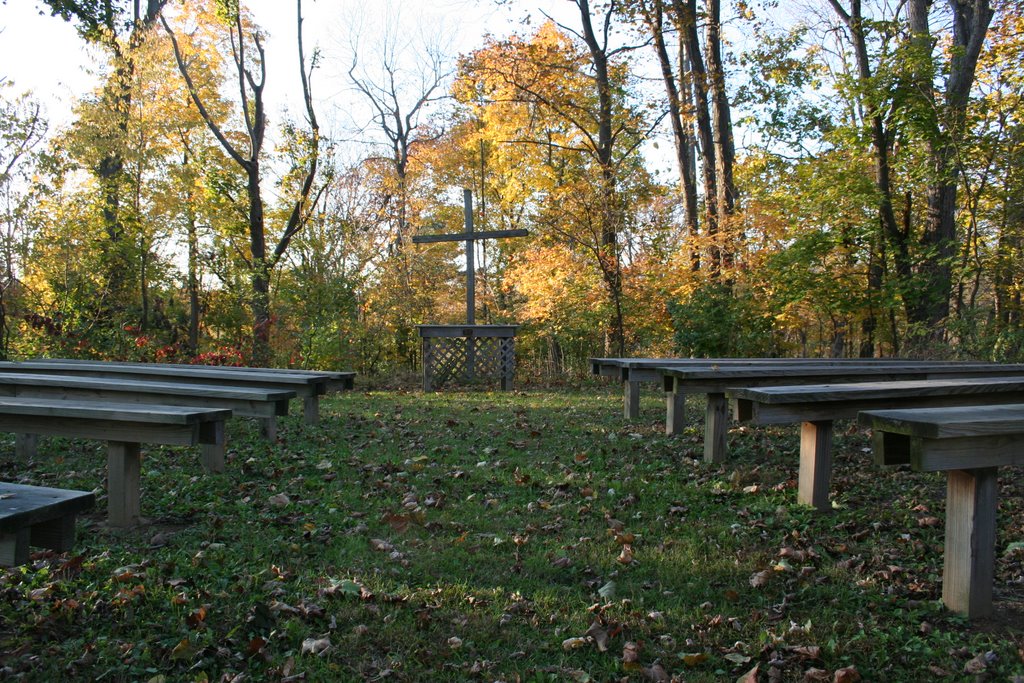 This weeks Sacred Space of the week does happen to be a type of a chapel. Several times a year chapel services are held here by different studend organizations. I've had two opportunities to be involved with services here. One in the evening with the Young Adult Seminarian Network. It was dark and the setting included tiki torches, candles, grapes, cheese, and crackers. The chapel was built and dedicated to a former maintence director at the school and is a very important part of the campus here at MTSO.
Tuesday, October 24, 2006
The Methodist Theological School in Ohio
Awhile back Rachel asked me to write about school and I'm finally getting around to it now.
I am in my second semester at the Methodist Theological School in Ohio seeking my call into ordained ministry in the United Methodist Church. I love it here, God could not have put us in a better place. Between classes and organization meetings there exists a beautiful community of people. They come from all kinds of backgrounds and have an enormous varities of interests. I found myself giving a tour today and talking about all the opportunities for families and kids, and the guy looked at me and said, well I'm not bringing a family with me. We kind of laughed about it and I related my experience of being brought into the family here at MTSO. While not every experience here is wonderful and life changing, it provides a real space to grow and learn.
Class wise this semester I am taking The Church's Educational Ministry, Introduction to Christian Ethics, Ministry For/With/By Youth, and Church History. They are all challenging, but with each class comes new opportunities.
Recently for a youth ministry paper I was required to have a conversation with a youth. We weren't given a list of questions or guidelines for the paper, simply that we listen for at least an hour. I got the opportunity to meet the sweetest kid named Steven. Steven really makes me feel great about the future. His sense of confidence, his warm smile, and his incredible work ethic was amazing to me. He has attended church off and on and he told me he likes it "if it's not too long or boring." It's cute, but it totally makes sense. The youth of today were raised with incredible amounts of stimulation present at all times: television, computers, gameboys, radios, etc... To hold any one youth's interest there needs to be a reason to be there that isn't too boring. I'm not going to give any kind of answer to what this is should be, beacuse for everyone it is different, but it's definatly something to think about. He's a good kid and I really believe he will get the spiritual guidence he needs to become a good Christian and a fabulous adult.
My biggest challenge here at MTSO has been discerning into what I'm really being called. There is no doubt in my mind that I'm truly being called to do the work of the church, but where is that call leading me. Someone told me today that God doesn't want to see me just floundering around and that I will get an answer... BUT WHEN?!
I guess that's enough about school for now. Peace out homies!
I am in my second semester at the Methodist Theological School in Ohio seeking my call into ordained ministry in the United Methodist Church. I love it here, God could not have put us in a better place. Between classes and organization meetings there exists a beautiful community of people. They come from all kinds of backgrounds and have an enormous varities of interests. I found myself giving a tour today and talking about all the opportunities for families and kids, and the guy looked at me and said, well I'm not bringing a family with me. We kind of laughed about it and I related my experience of being brought into the family here at MTSO. While not every experience here is wonderful and life changing, it provides a real space to grow and learn.
Class wise this semester I am taking The Church's Educational Ministry, Introduction to Christian Ethics, Ministry For/With/By Youth, and Church History. They are all challenging, but with each class comes new opportunities.
Recently for a youth ministry paper I was required to have a conversation with a youth. We weren't given a list of questions or guidelines for the paper, simply that we listen for at least an hour. I got the opportunity to meet the sweetest kid named Steven. Steven really makes me feel great about the future. His sense of confidence, his warm smile, and his incredible work ethic was amazing to me. He has attended church off and on and he told me he likes it "if it's not too long or boring." It's cute, but it totally makes sense. The youth of today were raised with incredible amounts of stimulation present at all times: television, computers, gameboys, radios, etc... To hold any one youth's interest there needs to be a reason to be there that isn't too boring. I'm not going to give any kind of answer to what this is should be, beacuse for everyone it is different, but it's definatly something to think about. He's a good kid and I really believe he will get the spiritual guidence he needs to become a good Christian and a fabulous adult.
My biggest challenge here at MTSO has been discerning into what I'm really being called. There is no doubt in my mind that I'm truly being called to do the work of the church, but where is that call leading me. Someone told me today that God doesn't want to see me just floundering around and that I will get an answer... BUT WHEN?!
I guess that's enough about school for now. Peace out homies!
Subscribe to:
Posts (Atom)